
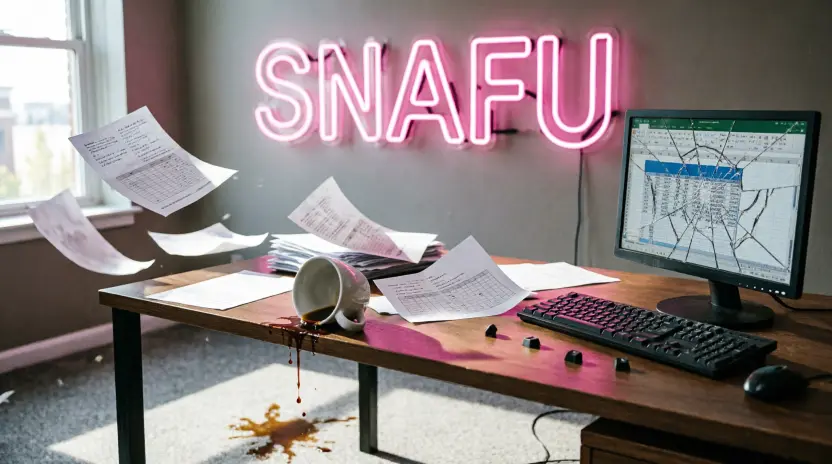
If you have seen “SNAFU” in a text message, social media post, online conversation, or comment and wondered what it means, you are not alone.
It is one of those slang terms that looks confusing at first because it does not resemble a normal English word.
SNAFU usually means “Situation Normal: All F*ed Up.”** It is a humorous or sarcastic way of saying that something has gone wrong, is messy, or is not working as expected even though the situation is being treated as if it is completely normal.
You may see it used when someone is dealing with a technical problem, a stressful day, a confusing situation, or a series of small mistakes. Depending on the person and setting, it can sound funny, frustrated, sarcastic, or mildly cynical.
Although SNAFU is commonly used as slang today, it is not a new internet abbreviation. The expression has a long history and was originally associated with military slang.
In this guide, we will look at the SNAFU meaning, where it came from, how people use it in texting and social media, examples of the term in real conversations, and when you should or should not use it.
SNAFU Meaning at a Glance
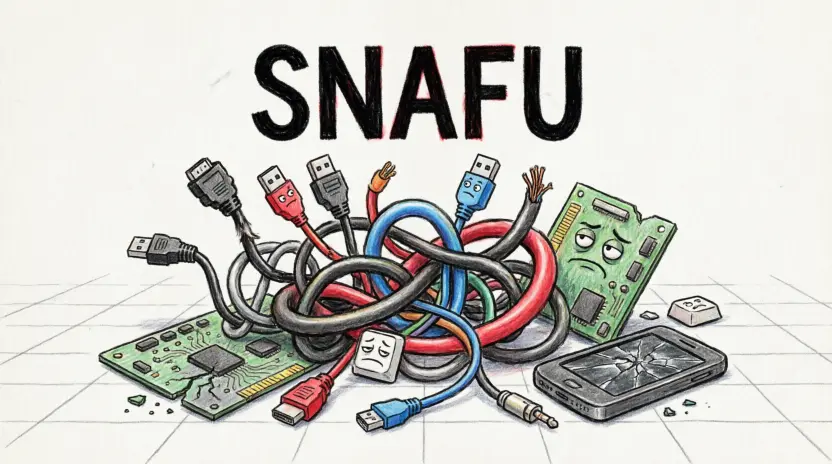
The most common meaning of SNAFU is:
SNAFU = Situation Normal: All F*ed Up**
In simple English, it means:
“Everything is messed up, but this kind of mess is considered normal.”
It can describe a situation where things have gone wrong in a familiar or expected way.
For example:
“The website is down again. SNAFU.”
The person is basically saying that the website having problems is frustrating, but unfortunately, it is not surprising.
Another example:
“Missed the bus, forgot my charger, and spilled coffee on my shirt. Total SNAFU.”
Here, the speaker is joking about a series of unfortunate events.
The word is usually written in capital letters as SNAFU, although people may also write it as snafu in casual online conversations.
What Does SNAFU Stand For?
SNAFU is an acronym. Each letter represents a word in the original phrase:
- S = Situation
- N = Normal
- A = All
- F = F***ed
- U = Up
The full expression contains profanity, which is why some people avoid writing out the phrase in professional or family-friendly settings.
The important thing to understand is that the phrase is intentionally ironic.
“Situation normal” suggests that everything is fine or ordinary. The rest of the expression says the opposite: things are seriously messed up.
That contrast is what gives SNAFU its humorous tone.
What Does SNAFU Mean in Texting?
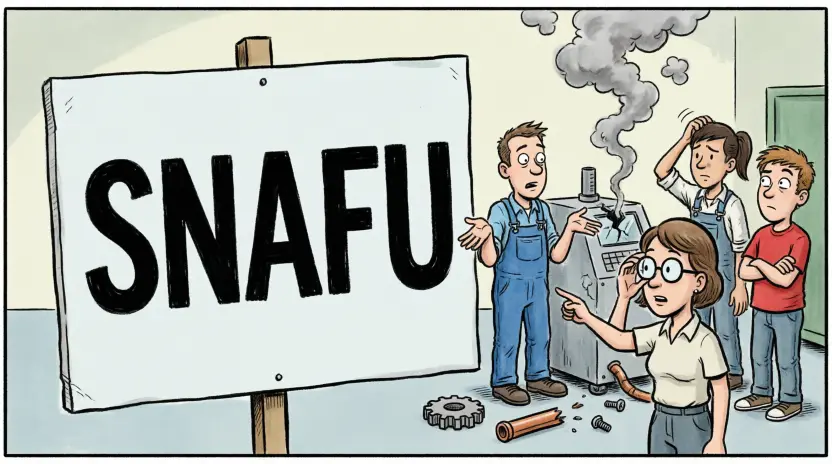
In texting, SNAFU usually means that something has gone wrong in a messy but unsurprising way.
Someone might use it after a frustrating experience without wanting to explain every detail.
For example:
Person 1: “Did the group project finally get submitted?”
Person 2: “Nope. SNAFU. The file disappeared.”
In this conversation, SNAFU communicates that the situation became a complete mess.
Another example:
“My morning was a SNAFU from start to finish.”
This means the person’s morning was full of problems.
Unlike some texting abbreviations such as “LOL” or “BRB,” SNAFU is usually not just a quick reaction. It describes a situation that is chaotic, broken, complicated, or badly managed.
Is SNAFU a Bad Word?
The answer depends on how it is being used.
The acronym itself contains a vulgar word. Because of that, SNAFU can be considered profanity or mildly offensive slang, especially in formal environments.
However, many people use it without intending to be seriously offensive. It is often used humorously to describe everyday problems.
For example:
“The printer is having another SNAFU.”
That sentence is probably meant as a lighthearted complaint.
Still, you may want to avoid using it in:
- Formal business emails
- School assignments
- Job interviews
- Professional presentations
- Conversations with people who may dislike profanity
- Family-friendly public content
In casual texting, online discussions, gaming communities, or conversations with friends, it may be perfectly understandable.
The History Behind SNAFU
SNAFU has been around much longer than modern social media.
The expression became well known as military slang during World War II. American military personnel used the phrase to describe situations in which confusion, mistakes, delays, and poor organization were common.
The humor came from calling a badly organized situation “normal.”
The expression became popular in military culture because it captured a familiar experience: plans may look organized on paper, but real-world situations can quickly become complicated.
Over time, SNAFU moved beyond military language.
It became part of broader American slang and eventually appeared in books, newspapers, movies, television, business discussions, technology communities, and internet conversations.
Today, many people use it without thinking about its military origins.
Why Do People Say SNAFU?
One reason SNAFU has remained popular is that it communicates a complicated feeling in just four letters.
Imagine someone has been trying to fix a computer problem for two hours. Every time they solve one issue, another one appears.
They could say:
“Everything is going wrong.”
Or they could simply say:
“It’s a SNAFU.”
The second version has a humorous, sarcastic quality.
It suggests:
“Yes, this is a disaster—but somehow, this is exactly the kind of disaster I expected.”
That combination of frustration and humor is a major part of the expression.
SNAFU Examples in Everyday Texting
Here are some natural examples of how people might use the term.
Example 1: Technology Problem
“The app crashed while I was submitting my order. SNAFU.”
Meaning: Something went wrong with the app and caused a frustrating problem.
Example 2: Travel Trouble
“Flight delayed, hotel lost my reservation, and my luggage is missing. Total SNAFU.”
Meaning: The trip has turned into a series of problems.
Example 3: Work Situation
“The meeting link doesn’t work and half the team can’t log in. SNAFU as usual.”
Meaning: The meeting has become chaotic, and the speaker is sarcastically suggesting that this kind of problem is normal.
Example 4: School
“Our presentation file won’t open. SNAFU.”
Meaning: The presentation has encountered a major problem.
Example 5: Daily Life
“I woke up late, missed breakfast, and forgot my keys. Today’s already a SNAFU.”
Meaning: The day started badly and has become messy.
What Does SNAFU Mean on Social Media?
On social media, SNAFU can be used in much the same way as it is in texting.
You might find it in posts about:
- Work problems
- Computer issues
- Travel disasters
- Politics or bureaucracy
- Customer service problems
- Everyday frustrations
- Gaming problems
- Failed plans
- Unexpected mistakes
Someone might post:
“Spent three hours fixing one thing and accidentally broke two others. SNAFU.”
The person is not necessarily describing a serious disaster. They may simply be making fun of an annoying situation.
On platforms where people use humor and sarcasm heavily, SNAFU can work as a short way of summarizing chaos.
SNAFU on Instagram
On Instagram, the term may appear in captions, comments, memes, or Stories.
For example:
“Vacation was supposed to be relaxing. Lost passport on day one. SNAFU 😂”
The word adds a sarcastic tone to the caption.
However, SNAFU is not one of the most common abbreviations on Instagram. You are more likely to see familiar expressions such as “LOL,” “OMG,” “IDK,” or “FR.”
If someone uses SNAFU, they may be deliberately choosing an older or more unusual slang term for comedic effect.
SNAFU on Snapchat
On Snapchat, people may use SNAFU in direct messages or captions when describing something that has gone wrong.
For example:
“My entire morning = SNAFU 😭”
The meaning is basically:
“My entire morning was a mess.”
Because Snapchat conversations are generally informal, the slang expression can fit naturally between friends.
Still, the term is not specific to Snapchat. Its meaning remains the same across most platforms.
SNAFU in Gaming
SNAFU can also appear in gaming communities.
A player might say:
“The server crashed during the final round. SNAFU.”
Or:
“We had a perfect strategy until the connection went down. Absolute SNAFU.”
Here, the term describes an unexpected technical or organizational failure.
Gamers sometimes use older slang and military terminology because gaming culture has long included words related to missions, operations, teams, tactics, and failures.
SNAFU vs. FUBAR
If you have encountered SNAFU, you may also come across another old military slang term: FUBAR.
They are related, but they are not exactly the same.
SNAFU means that a situation is messed up or going badly while being treated as normal.
FUBAR is generally stronger and means that something is completely messed up or beyond repair.
For example:
“The office printer is having a SNAFU.”
This suggests that the printer is causing problems.
But:
“The printer is completely FUBAR.”
This suggests that the printer is seriously broken.
Both terms can contain profanity in their original expansions, so neither is ideal for formal writing.
SNAFU vs. Clusterf***
Another expression sometimes associated with SNAFU is clusterf*.
A clusterf*** describes an extremely chaotic, badly organized, or confused situation.
The difference is mostly in tone and emphasis.
SNAFU often carries the idea that problems are expected or routine.
A clusterf*** usually emphasizes extreme confusion or incompetence.
For example:
“The office’s broken printer is another SNAFU.”
This sounds almost resigned.
“The entire event turned into a clusterf***.”
This sounds much more intense.
Is SNAFU an Acronym or Slang?
It is both.
Technically, SNAFU is an acronym, because it is formed from the first letters of a phrase.
In everyday language, it is also considered slang because it is an informal expression used to describe a situation.
Interestingly, SNAFU has become so established that people sometimes use it like an ordinary noun or adjective.
For example:
“We had a SNAFU with the booking.”
Here, SNAFU functions as a noun.
Someone might also say:
“The whole process is completely snafu.”
That usage is less standard and less common, but it shows how acronyms can gradually turn into ordinary vocabulary.
How to Pronounce SNAFU
SNAFU is usually pronounced as one word:
“sna-foo”
It sounds roughly like:
SNAH-foo
Unlike some acronyms that are pronounced letter by letter, such as “FBI,” SNAFU is generally spoken as a word.
If you see it written in a conversation, you can read it as “sna-foo.”
Does SNAFU Always Mean Something Serious?
No.
This is an important part of understanding the slang.
People often use SNAFU for relatively small problems.
Someone could say:
“My breakfast plans were a SNAFU.”
That does not necessarily mean anything terrible happened. Maybe the restaurant was closed, the order was wrong, or everyone arrived at different times.
The word often adds dramatic humor to an ordinary inconvenience.
That is why context matters.
If someone says:
“The evacuation plan became a SNAFU.”
That could refer to a genuinely serious problem.
If someone says:
“Making coffee this morning was a SNAFU.”
It is probably just a joke.
Is SNAFU Rude?
It can be.
The original phrase includes profanity, so you should consider your audience before using it.
Among close friends, it may sound funny and casual.
In a professional workplace, however, it could be viewed as inappropriate.
For example, instead of writing:
“The project is a SNAFU.”
in a formal email, you could write:
“We have encountered several unexpected issues with the project.”
That communicates the same general idea without slang or profanity.
Polite Alternatives to SNAFU
If you want to express the same idea without profanity, there are plenty of alternatives.
You could say:
- “Everything is a mess.”
- “Things have gone wrong.”
- “We have a problem.”
- “It’s a bit chaotic.”
- “Things got complicated.”
- “We’re dealing with several issues.”
- “Everything went sideways.”
- “It’s a complete mess.”
- “This situation is chaotic.”
- “Nothing is going according to plan.”
For casual conversation, “everything went sideways” is a particularly useful alternative because it has a humorous feel without the profanity associated with SNAFU.
How to Respond When Someone Says SNAFU
“Sounds like a normal Tuesday 😂”
“Oh no. What happened?”
“Got it. What needs fixing first?”
You do not need to respond to the acronym itself. Simply understand that the person is probably saying that something has gone wrong.
SNAFU in a Sentence
Here are several natural sentences using the word:
- “The whole schedule became a SNAFU after the flight was canceled.”
- “We had a little SNAFU with the order.”
- “The website update turned into a complete SNAFU.”
- “Everything was going smoothly until the server crashed. Classic SNAFU.”
- “Our weekend plans were a SNAFU from the beginning.”
- “There was a SNAFU with the delivery address.”
- “The meeting was a SNAFU because nobody had the correct link.”
Notice that the term often works best when the speaker is describing a problem involving several things going wrong at once.
Common Misunderstandings About SNAFU
Because the word looks unusual, people sometimes misunderstand it.
SNAFU does not mean “fine”
The phrase contains the word “normal,” but SNAFU is actually describing a situation that is far from ideal.
The humor comes from calling a messed-up situation “normal.”
It is not a modern internet acronym
Although you may see SNAFU online, it existed long before social media, smartphones, and texting.
Its roots are generally traced to military slang from World War II.
It does not always describe a disaster
Someone can use SNAFU for something small and annoying.
It is often exaggerated for comedic effect.
It is not appropriate everywhere
Because its original expansion contains profanity, SNAFU may not be suitable for formal or professional communication.
Why SNAFU Still Works Today
Language changes quickly, especially online. New abbreviations appear all the time, while others disappear after a few years.
SNAFU has lasted because the situation it describes is timeless.
People have always dealt with:
- Broken technology
- Confusing instructions
- Missed deadlines
- Communication failures
- Bureaucratic problems
- Poor planning
- Unexpected delays
- One mistake leading to another
The phrase captures that experience in a memorable way.
There is also something relatable about its attitude. Instead of simply complaining, the speaker is often laughing at the absurdity of the situation.
That makes SNAFU particularly useful when someone wants to sound frustrated and humorous at the same time.
SNAFU Meaning in Simple English
If you want the shortest possible explanation, remember this:
SNAFU means that something is badly messed up or going wrong, often in a way that feels frustratingly normal or expected.
It comes from the phrase “Situation Normal: All F*ed Up.”**
The term is commonly used informally and can appear in texts, online conversations, social media posts, workplaces, gaming communities, and discussions about everyday problems.
Because the original phrase includes profanity, use it carefully in professional situations.
FAQs:
What is the full meaning of SNAFU?
SNAFU stands for “Situation Normal: All F*ed Up.”** It is an informal expression for a situation that is chaotic, problematic, or badly messed up.
What does SNAFU mean in texting?
In texting, SNAFU usually means something has gone wrong or become a mess. It is often used humorously or sarcastically.
Is SNAFU a swear word?
SNAFU itself is an acronym, but its original phrase contains profanity. Because of this, it can be considered inappropriate in some formal settings.
Is SNAFU still used today?
Yes. Although it originated as military slang, it is still used in informal conversations, online discussions, workplaces, technology communities, and social media.
What is another word for SNAFU?
Depending on the context, alternatives include mess, chaos, problem, mix-up, disaster, complication, or everything went sideways.
Is SNAFU the same as FUBAR?
No. Both are expressions associated with military slang, but SNAFU usually suggests that a messed-up situation has become normal or expected. FUBAR generally suggests that something is extremely or completely messed up.
Can I use SNAFU in a work email?
You can, but it depends on your workplace and audience. Since the original expression contains profanity, a more professional phrase such as “unexpected issue,” “complication,” or “technical problem” is safer.
How do you pronounce SNAFU?
It is generally pronounced “sna-foo.”
Final Thoughts:
SNAFU is an unusual-looking slang term with a surprisingly long history.
While you may first encounter it in a text message, meme, comment, or social media post, the expression actually dates back to military slang from the World War II era.
Today, its basic meaning is simple: something has gone wrong, things are messy, and the situation is frustratingly normal.
The term is often used with humor. Someone might describe a broken computer, failed travel plans, a confusing work project, or an unlucky morning as a SNAFU.
In many cases, the speaker is not trying to sound overly serious. They are using the word to laugh at a frustrating situation.
Just remember that the original phrase contains profanity. That makes SNAFU better suited to casual conversations than formal writing.
So, if someone texts you “It’s a SNAFU,” they are most likely saying:
“Things are messed up again, and somehow this is completely normal.”
That is the basic idea behind the slang and once you know it, the acronym becomes much easier to understand when you see it online.
Discover more post:
| https://meaninggly.com/wlw-meaning/ |
| https://meaninggly.com/nsfw/ |
| https://meaninggly.com/iykyk-meaning/ |

Zoya is a passionate content writer and creative author with over 5 years of experience in writing engaging, informative, and SEO-friendly content. She specializes in English language topics, meanings, metaphors, literature, lifestyle, and creative writing.
She is currently working with MeaningGly, where she creates unique and reader-friendly articles that help people understand words, expressions, and modern language trends in a simple way.
2 thoughts on “What Does SNAFU Mean in Text? Real Meaning, Examples”